





1n a gathering that brought together Nigeria’s top media executives, government representatives, and press freedom advocates, the 2025 International Press Institute (IPI) Nigeria Conference and Annual General Meeting (AGM) spotlighted urgent challenges and opportunities for the country’s journalism sector.
The conference held at the nation’s capital, December 2 and 3,2025, underscored the pressing need for media houses to innovate, uphold credibility, secure sustainable revenue streams, and protect journalistic freedoms.
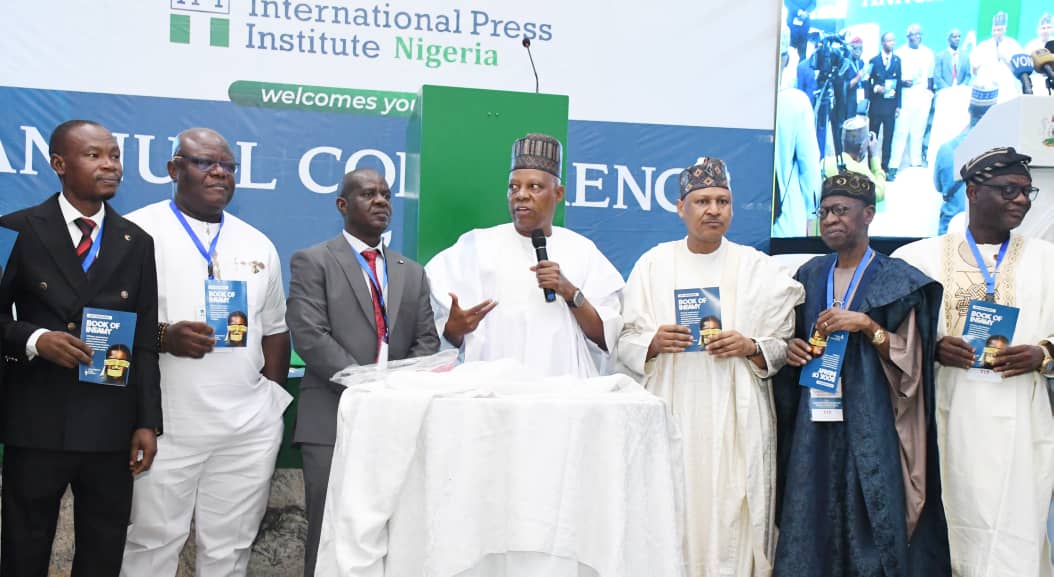
Vice President Kashim Shettima, in his keynote address called on journalists to defend truth and maintain the highest standards of ethics.
“Journalism remains essential to accountability, transparency and national cohesion. Government officials must not suppress the press. Democracy thrives only when journalists can work freely,” Shettima said.
He warned that democracy collapses when the media is intimidated into silence, emphasising that journalists must continue to play their role as watchdogs of society.
The Vice President also highlighted the responsibility of media houses to uphold accuracy and avoid sensationalism, urging them to foster public trust.
He reaffirmed the Federal Government’s commitment to press freedom, professional development for journalists, and media literacy.
“The government will continue to support initiatives that strengthen journalistic capacity while ensuring ethical, responsible reporting,” Shettima said.
He warned that democracy collapses when the media is intimidated into silence, emphasising that journalists must continue to play their role as watchdogs of society.
The Vice President also highlighted the responsibility of media houses to uphold accuracy and avoid sensationalism, urging them to foster public trust.
He reaffirmed the Federal Government’s commitment to press freedom, professional development for journalists, and media literacy.
“The government will continue to support initiatives that strengthen journalistic capacity while ensuring ethical, responsible reporting,” Shettima said.
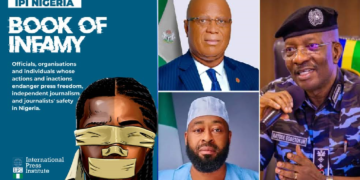
In his welcome address, the President of IPI Nigeria, Mr Misikilu Mojeed, while warning that attacks on journalists in Nigeria are becoming more frequent and dangerous, unveiled the Institute Book of Infamy, naming the Inspector General of Police Kayode Egbetokun, Niger State Governor Mohammed Umar Bago, and Akwa Ibom State Governor Umo Eno as “enemies of the media.”
According to him, IGP Egbetokun failed to prevent arbitrary arrests of journalists across Nigeria, undermining press freedom; Governor Eno was cited for barring the crew of Channels TV from covering the Akwa Ibom State Government House; while Governor Bago was named for ordering the closure of private radio station Badeggi FM.
IPI Nigeria revealed that despite appeals to reconsider their actions, both governors refused to reverse their decisions, even though they lacked constitutional authority to enforce such measures.
The Institute, however, conversely, declared DSS Director-General Adeola Ajayi as a “friend of the media” for his responsiveness, professional conduct, and commitment to protecting journalists.
During the conference, the contributions of DSS DG Adeola Ajayi was mentioned, commending him for demonstrating professionalism, openness, and responsiveness to media concerns.
His interventions ensured the swift release of wrongfully detained journalists and reinstated media executives unfairly targeted over decades.
IPI Nigeria highlighted his interventions, which included removing Executive Director of the International Press Centre, Lanre Arogundade, from a government watchlist after nearly 40 years, and facilitating the quick release of journalists wrongfully detained by DSS operatives.
Responding to the revelations, Vice President Shettima promised to engage with the parties involved, to resolve the Channels TV issue and assured that he would reach out to Governor Bago and the IGP to address the IPI’s concerns.
“Those exposing misconduct and holding public officials accountable are increasingly targeted. Harassment, intimidation, arrests, and threats from security agencies and political actors are on the rise,” The IPI Nigeria president, said.
He also paid tribute to late broadcaster Rafat Salami, highlighting her courage and integrity as symbolic of journalistic excellence.
The IPI Nigeria president called for urgent reforms to safeguard journalists, enforce constitutional guarantees, and protect whistleblowers.
In his remarks the Minister of Information and National Orientation, Mallam Mohammed Idris, used the platform to announce the launch of the Media and Information Literacy (MIL) Institute, aimed at equipping journalists, students, and digital creators with tools for fact-checking, digital literacy, and ethical reporting.
Mallam Idris stressed that the government prefers persuasion and engagement over coercion in addressing harmful content.
“The media is an essential pillar of democracy. Practitioners must uphold professionalism, accuracy, fairness, and responsibility at all times,” he said.
The minister further reiterated the government’s commitment to creating an enabling environment that promotes media freedom while strengthening ethical standards.
The co-founder and former Managing Director of Media Trust, Alhaji Isiaq Ajibola, warned that Nigerian media organisations risk collapse unless they embrace innovation, restore credibility, and develop sustainable revenue models.
“Outdated newsroom structures are failing. Digital transformation, data analytics, capacity building, content diversification, and multiple revenue channels are now compulsory, not optional,” Alhaji Ajibola said.
He cautioned that innovation without credibility is meaningless, as audiences will not rely on media platforms that compromise accuracy.
He further urged the government to end hostility toward the press and support regulatory frameworks that foster innovation, fair competition, and press freedom.
Also speaking, the Executive Director of Media Rights Agenda (MRA), warned that the growing political, economic, and security threats to media independence.
“Journalists face arrests, intimidation, and censorship, undermining the constitutional responsibility of the media as stated in Section 22. Press freedom is not a privilege; it is a governance requirement,” Mr Ojo declared.
He stressed that judicial, legislative, and institutional reforms are urgently needed to protect journalists and ensure accountability and transparency in governance.
The 2025 IPI Nigeria Conference, attended by members across the country also inducted new members picking from various strater of the profession, underscored the urgent need for collaboration among government, media organisations, and civil society to safeguard press freedom, improve ethical standards, and drive sustainable innovation across Nigeria’s media landscape.
